
Why That Zero-Privacy Parlour Hangout Is Straining Your Shared Flat
In a shared Lagos flat where thin walls kill personal space, a daily parlour hangout quickly became an unwritten law. Here is how flatmates drew the line between routine and obligation.
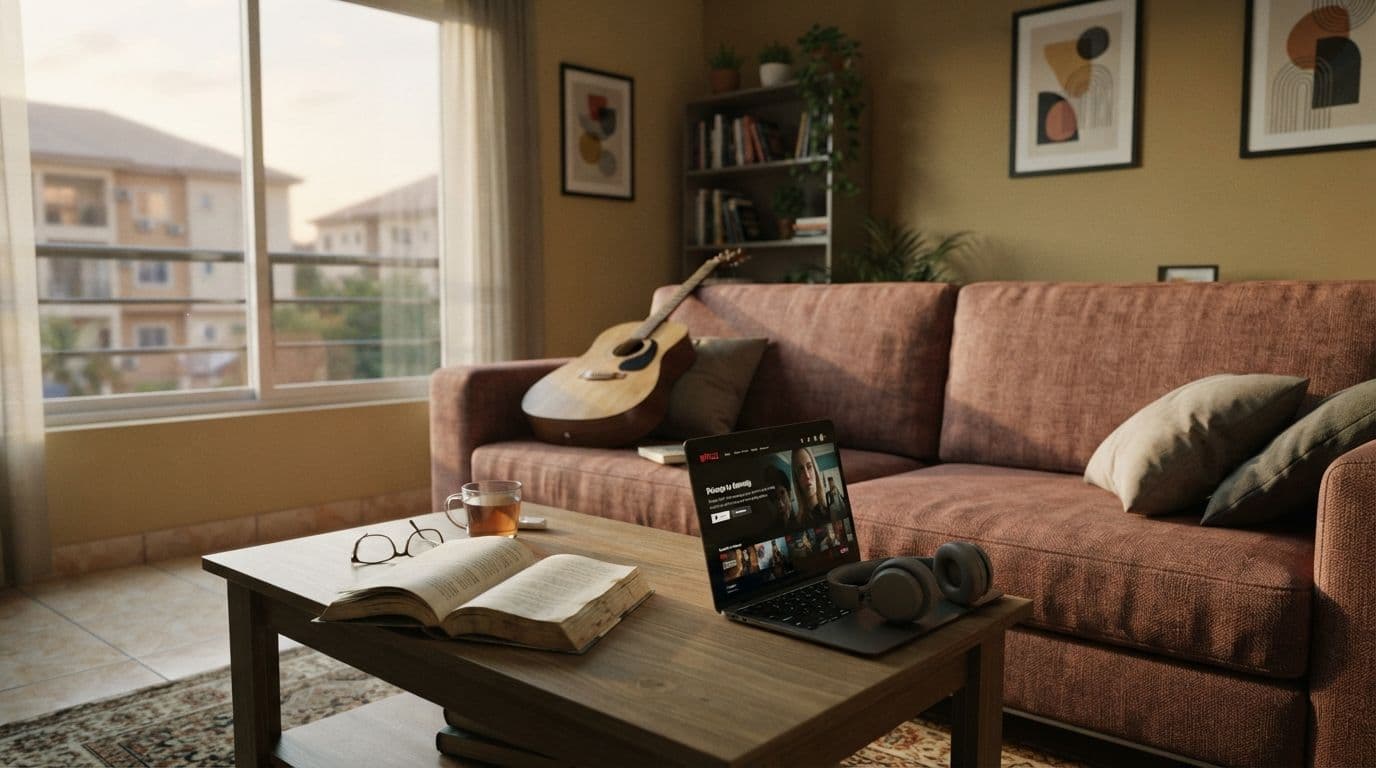
The front door of the shared flat in Akoka had a brass lock that did not quite catch unless you lifted the handle with both hands. It meant every arrival was noisy, announcing itself to anyone sitting on the faux-leather sofa four feet away.
For three months, that parlour was a refuge. Segun, Dami, and Chidera shared the three-bedroom flat because splitting two million naira rent made better financial sense than living in isolated, expensive studios. In the beginning, the nightly ritual in the living room happened organically. Someone would set a pot of jollof rice on the dining table, another person would link a phone to the Bluetooth speaker, and they would decompress from mainland traffic together.
By month five, however, that casual decompression had morphed into a compulsory shift.
If Segun walked straight from the front door into his bedroom after an exhausting commute from Victoria Island, someone on the sofa would inevitably ask, "Ah, Segun, are you vexing for us?" If Dami closed her door to take a private phone call, the living room felt the silence like a personal insult. The shared flat had lost the boundary between voluntary companionship and enforced social attendance.
The Unspoken Tax of Living in Full View
Shared housing often begins with high hopes of communal warmth. When adults pool resources to secure decent housing, the shared living room acts as the primary social anchor. The science of shared activities shows that repeating low-stakes interactions helps people build genuine social bonds without high emotional friction.
Trouble begins when ambient friendship turns into an unspoken contract. When four people live in a layout where every bedroom opens directly into the common area, solitude requires conscious negotiation.
In Segun's flat, closing a bedroom door was treated as an act of withdrawal rather than an act of rest. Because nobody had private space outside their personal four walls, the parlour became a surveillance deck. Everyone knew who received food deliveries, whose partner called at 11:00 p.m., and who was avoiding a conversation about the shared inverter maintenance.
When a home offers zero spatial privacy, people often compensate by establishing rigid shared habits. But when those habits demand constant participation, they stop being relaxing. As explored in why a quiet person should not have to host every time, communal energy should never rely on forcing introverted residents into performing constant availability.
How Shared Habit Quietly Becomes Enforced Duty
There is a distinct structural difference between a routine and an obligation:
- A routine is an open door: you join because it adds ease, comfort, or joy to your evening. * An obligation is a closed gate: you join because skipping it invites passive aggression, awkward questions, or guilt.
In relationship psychology, intentional daily habits—often called rituals of connection—succeed only when participation is freely offered rather than extracted. When flatmates confuse proximity with constant entitlement to each other's time, domestic fatigue sets in quickly.
One Thursday evening, Dami returned from an eight-hour video production shoot with a throbbing headache. She slipped off her shoes, mumbled a brief greeting, and turned toward her corridor. Chidera looked up from the television, pausing the show.
"Dami, wait na. The suya guy is outside. Are you not staying to watch the match?"
"I really just want to sleep, Chidera. My head is pounding."
"Haba. Just twenty minutes. We haven't even talked today. You're always locking yourself inside these days."
That single exchange captured the problem. Chidera viewed the living room as a communal fireside where good flatmates proved their loyalty. Dami experienced the same living room as a checkpoint she had to survive before reaching her bed.
The Cost of the Performance
When co-living spaces enforce social routines, domestic life turns into secondary office politics. People start calculating their arrivals. Segun began sitting in his car down the street for twenty minutes just to finish listening to a podcast without someone talking over it.
Dami began ordering private dinners and eating them quietly in her room, balancing the takeout pack on her bed sheets to avoid the mandatory communal dinner debate in the kitchen. When personal boundaries are not explicitly stated, resentment grows in small, petty increments. Dishes left in the sink become symbols of emotional resistance; forgotten light switches turn into passive-aggressive battles in the group WhatsApp chat.
Much like handling friction when the friend who always organises assumes everyone wants identical levels of social contact, flatmates must acknowledge that living together does not equal spending every waking evening as an ensemble cast.
Resetting the Boundaries Without Starting a War
The breakthrough in the Akoka flat did not happen through an explosive argument. It happened on a Sunday afternoon when the generator ran out of fuel.
With the power out and the living room uncomfortably hot, all three flatmates found themselves sitting on the balcony steps. Segun took the opening.
"Guys, I want to say something, and I don't want anybody to take it personal," he began, leaning against the railing. "I love this flat, and I love that we get along. But some days, when I enter this house, I don't have the bandwidth to talk. When I go straight to my room, it's not beef. It's just survival."
Chidera blinked, initially defensive. "Nobody is forcing you to talk, Segun. We're just trying to keep the vibe in the house good. If everyone just locks their door, then we're just strangers sharing a bill."
"That's the thing," Dami interjected. "We aren't strangers. But when being in the parlour feels like attendance at a morning assembly, it makes me dread coming home. A routine is only good if you can skip it without giving an excuse."
The conversation lasted nearly an hour. They did not draft a rigid house constitution, but they agreed on three practical operating rules:
- A closed bedroom door is neutral territory. It indicates rest, work, or focus, not a personal dispute. 2. The parlour is opt-in. Sitting in the common area does not require engaging in every conversation or staying for the duration of a movie. 3. No guilt-tripping at the front door. A simple greeting upon entry is sufficient; nobody has to debrief their entire workday before taking off their shoes.
The Trap of Domestic Surveillance
When walls are thin and corridors are narrow, casual proximity easily turns into unintentional monitoring. In flats across Yaba and Surulere, where older residential buildings have been converted into multi-tenant units, acoustic privacy is practically non-existent. A phone vibrating against a nightstand resonates through the adjoining partition; the click of an electric kettle signals to the entire flat that someone is awake and making tea.
In Segun and Dami’s flat, this continuous sensory spillover created an environment where everyone’s private schedule was inadvertently public knowledge. If Chidera noticed that Segun had not left his room by 8:00 a.m. on a Saturday, she would knock lightly to ask if he wanted beans from the vendor down the street. It began as genuine kindness, but over time, it meant Segun could never simply lie in bed undisturbed. Choosing to wake up slowly without speaking to anyone was interpreted as an anomaly that required checking in.
This kind of low-level visibility often forces people into performing wellness. When you know that stepping into the hallway means explaining your mood or answering questions about your plans, even simple domestic actions become heavy. You hold off on getting a glass of water because you do not have the energy to exchange pleasantries. You wait until you hear another flatmate’s bedroom door shut before you leave your own room to use the bathroom. The living space ceases to feel like a sanctuary and begins to function like a stage where you are permanently on display.
Differing Definitions of Communal Harmony
Conflict in shared spaces rarely stems from outright malice. More often, it arises from two completely reasonable, yet contradictory, domestic philosophies colliding under one roof.
For residents like Chidera, a lively parlour is the benchmark of a healthy household. Having grown up in a busy family compound in Enugu where empty rooms were viewed with suspicion, silence felt cold, transactional, and unsafe. To her, coming home to an empty living room felt like living in a boarding house of detached strangers. If people were not actively talking, sharing snacks, or debating politics over the television, it felt like the domestic contract was failing. She treated the parlour as a collective hearth where solidarity had to be continually renewed.
For Dami, who worked as an independent creative contractor dealing with high client demands all day, home represented the only place where she was not required to respond to anyone. For her, true domestic peace was not noise or camaraderie; it was autonomy. When she contributed her share of the generator maintenance and cleaning supplies, she fulfilled what she considered the primary flatmate contract. Anything beyond that—movie nights, collective cooking, debriefing the day—was an optional social extra, not a core requirement.
Neither perspective is inherently flawed. The tension emerges when one party treats their personal social preference as the moral default for the whole flat. Opting out of a common room is not a rejection of the community; it is simply personal energy management.
Practical Boundaries for Small Living Quarters
Restoring privacy in a zero-boundary flat does not require cold hostility or architectural redesign. It requires practical, visible signals that allow flatmates to disengage without causing social offence.
In many shared Lagos apartments, clear non-verbal cues help remove the guesswork from domestic interactions:
- Headphones as a physical signpost: Putting on over-ear headphones while preparing food in the kitchen or sitting in the common area signals that you are taking a personal breather and are unavailable for long conversations. * The direct greeting exit: Instead of pausing in the living room out of politeness before attempting an escape, offer an intentional greeting paired with an explicit exit: "Good evening, everyone. My day was heavy, so I am heading straight to sleep." * Separating chores from socialising: Agreeing on shared responsibilities like inverter fuel contributions or water pump scheduling over a group chat reduces the need to trap each other in the living room for administrative discussions.
Adopting these small conventions ensures that the flat remains functional and friendly without requiring flatmates to surrender their need for quiet recovery.
Living Together Without Losing Yourself
A shared flat is an economic partnership that thrives on mutual respect, not enforced intimacy. Shared routines—eating dinner together on Fridays, watching football on weekends, or splitting fuel costs—are valuable precisely because they remain voluntary.
The Akoka parlour did not become cold or empty after that Sunday conversation. The TV still ran on weekday nights, and jollof rice still made its way to the dining table. But on the nights Segun slipped straight into his room with a nod and a wave, the room simply let him go.
A home only feels safe when walking into your private room requires no permission, no apology, and no explanation.