
Unplugging the 7 PM Screen: Reclaiming the Living Room Desk in a Tight Flat
When remote work turns a compact flat's parlour into a permanent office, evening peace evaporates. Here is how to negotiate hard boundaries between shared workspace and home.
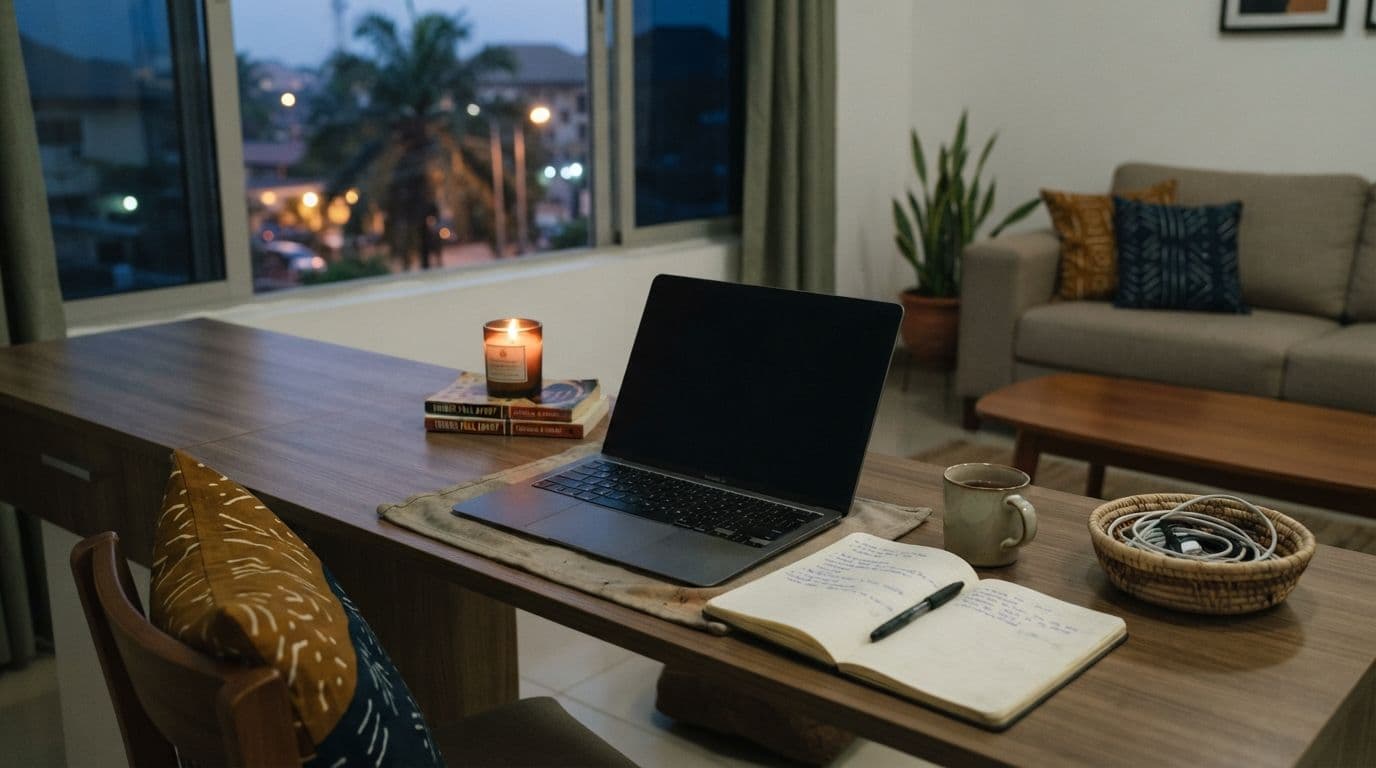
The low hum of the inverter fan was the only sound in the flat until Tunde clipped his ring light to the edge of the dining table.
It was past seven on a Tuesday evening in Yaba. Shade had already packed her laptop into a canvas tote, kicked off her sandals, and settled onto the corner sofa with a bowl of pepper soup. She wanted thirty minutes of stillness before starting dinner. Instead, the wooden surface three feet away became an illuminated conference station. Tunde cleared his throat, pitched his voice into corporate optimism, and began running an operations sync across three time zones.
"Let's double-click on the Q3 handover pipeline," he said into his boom microphone.
The living room desk setup immediately took over the room. The parlour stopped feeling like a home they paid ₦2.8 million annually to share; it turned into an open-plan branch of a logistics firm. Shade could not chew without wondering if the sensitive mic was picking up the crunch. She could not stretch out in her faded house dress without brushing the edge of the webcam's wide lens.
This friction is familiar across Nigerian city rentals where space is tight and a dedicated home office is an expensive luxury. When a job permanently occupies the parlour table, the conflict is not merely about square footage. It becomes a quiet contest over who dictates the mood of the flat after dark.
How the Dining Table Became an Immovable Office
When they took the one-bedroom apartment eighteen months earlier, the division of space seemed simple. The table would serve three purposes: quick breakfasts at dawn, focused work during standard business hours, and shared meals by dusk.
Within three months, hardware conquered the room. A second monitor arrived, followed by a mechanical keyboard, a web of braided HDMI cables pinned along the skirting boards, and a heavy surge protector that took permanent root under the table. The wooden dining chairs were swapped for high-backed ergonomic seats that blocked the narrow path to the kitchen.
What began as a shared surface hardened into a permanent corporate fixture.
Physical clutter brings social weight. An open laptop does not sit quietly; it broadcasts vigilance. It silently announces that downtime is secondary and productivity is ongoing. When one person finishes at five while the other answers overseas tickets until nine, the off-duty partner remains trapped in an ambient office.
As explored in our look at how co-living boundaries collapse without clear household terms, undefined shared territory breeds silent resentment. When your only spot to decompress is also your partner's command centre, the workday never truly ends.
The Breakdown of Evening Ease
A home is not merely shelter from traffic and power cuts; it is a predictable setting for relational restoration. When every corner of the living area demands professional decorum, spontaneous comfort disappears.
Couples need simple, repeatable habits to step out of work mode. Research published by the Gottman Institute on relationship rituals underscores that deliberate daily touchpoints—like an uninterrupted greeting or quiet decompression talk—anchor long-term stability. But when one partner is unmuting to answer a product lead while the other reheats stew, that transition is broken. The greeting becomes a muted wave; the evening catch-up is replaced by a hushed request to keep the television volume under ten.
Shade spent several evenings lingering in the narrow corridor by the kitchen, checking her phone against the wall just to avoid the glare of the monitors.
"I shouldn't have to hide in the passage because you're talking about sprint velocity," she said later that night after his headset clicked off.
"This remote role pays sixty percent of our rent," Tunde replied. "The fuel we run during the day powers both our machines. I'm not scrolling on social media; I'm working."
His argument was practical. In an economy where maintaining foreign-denominated or tech contracts requires absolute reliability, his commitment was sensible. Yet financial contribution does not erase daily irritation. His need to deliver did not eliminate her need to take off her public face inside her own sitting room.
The Glare of Public Performance in Private Spaces
Remote work demands a level of posture and presentation that is fundamentally at odds with domestic vulnerability. Video meetings require bright lighting, composed expressions, and a curated background. A living room requires dim lamps, loose clothing, relaxed posture, and freedom to make noise without permission.
When those two modes collide in a small room, work almost always wins. It carries the urgency of livelihood, making rest look unproductive by comparison.
This dynamic mirrors what happens when free amenities turn a private parlour into an open house: once functional demands take root in a common area, domestic comfort gets pushed to the margins.
The primary disturbance is rarely the computer itself. It is the invisible boundary the working partner casts across the room. A live microphone turns the entire sitting room into a broadcast zone where the other person must tiptoe, speak in whispers, and dodge camera angles. Over weeks, that enforced caution produces steady exhaustion.
Mismatched Clocks and Asymmetric Rest
The issue sharpens when two people work on misaligned hours. In many households, one partner works standard local business hours while the other reports to regional hubs across different time zones. When shifts run into late evening, the flat never experiences a clean end to the day.
For the partner who finishes before nightfall, the flat should pivot into rest. But if the other person's core collaboration begins at six, the parlour remains locked in high gear. Food cannot be prepared with normal clatter, music cannot play, and walking between the sofa and the fridge feels like walking through a recording studio.
The working partner feels rushed and judged for doing their job, while the waiting partner feels stranded in a home they subsidise. When rest requires formal clearance, domestic life wears thin.
Four Rules That Restored the Common Room
Resolving spatial friction requires explicit rules rather than daily emotional debates. Relying on mutual goodwill in the middle of a tight deadline rarely works; couples need firm spatial and operational lines.
Building sustainable shared routines requires deliberate structure, a principle highlighted in studies on adult connection through structured spaces. Without clear containers for labour and relaxation, professional habits consume every square foot.
For Shade and Tunde, settling the living room desk dispute required four practical adjustments:
- The Seven O'Clock Packdown: Unless a severe operational failure occurs, all laptop screens at the dining table must close by 7:00 PM, with accessories stowed into a dedicated wicker storage box. * Relocating Evening Calls: Any voice or video meeting occurring after seven must be taken from the bedroom or the balcony, freeing the sitting room for casual use. * Sensory Containment: Replacing loud mechanical keyboards with quiet membrane keys, clipping monitor cables out of sight, and using directional desk lamps instead of overhead white bulbs kept the workspace contained. * A Physical Divider: Setting up a lightweight, three-panel folding divider behind the desk blocked camera sightlines and allowed the other partner to move around without appearing in the background.
The Hidden Tax on Weekend Morning Ease
The invasion of shared domestic space rarely confines itself to weekday evenings. By Saturday morning, the living room desk often exerts a silent, persistent gravity that reshapes how couples experience their time off.
In many compact flats across Lagos, the table that holds monitors and docks during the week remains an active reminder of pending tasks on the weekend. Even when machines are asleep, the presence of work equipment keeps the room in a suspended state. One partner might want to sit with a mug of tea, listen to highlife on the speaker, and spread out groceries on the dining surface. Instead, they find themselves negotiating around dual-monitor arms and tangled charging bricks.
This ambient pressure changes the psychological temperature of the home. When work instruments sit permanently in plain view, taking real downtime feels like an act of defiance rather than an ordinary domestic right. The off-duty partner often ends up retreating to the bedroom just to escape the visual noise of an unresolved project, leaving the most comfortable, well-ventilated room in the house functionally abandoned.
Establishing regular domestic resets—such as clearing hardware entirely off the main table on Friday nights—helps preserve communal downtime. Like having a regular check-in instead of a performance review, small habitual resets keep minor domestic frictions from hardening into chronic resentment.
The Power Dynamic of the Higher Earner’s Schedule
When one partner’s remote salary covers a larger share of the household budget, an unspoken hierarchy can easily distort how living space is allocated. The person whose work brings in significant income may feel an implicit entitlement to claim the best corner, run loud calls at odd hours, or demand silence across the flat.
This creates a subtle but damaging imbalance. The other partner begins to feel like a lodger in their own home, constantly accommodating the professional demands of someone else. Everyday actions—cooking dinner, running a blender, or inviting a sibling over for a quick visit—suddenly require clearance.
Financial contribution cannot be the sole metric for determining who controls the parlour. A tenancy agreement gives both partners equal claim to ease and quiet enjoyment, regardless of who pays what percentage of the rent. When income disparity is used to justify monopolising the common area, domestic partnership quietly degrades into a landlord-tenant dynamic.
Navigating this requires separating financial logistics from daily courtesy. Just as couples must establish fair agreements when talking about money before moving in, they must ensure that living spaces remain democratically shared, regardless of whose career demands more bandwidth.
Practical Spatial Swaps for Small Footprints
Reclaiming the parlour does not always require renting a larger flat. Often, small and pragmatic adjustments to the layout can resolve constant friction without substantial expense.
One effective strategy is rotating functional zones based on time of day. If the dining table must serve as a desk during standard business hours, the household can establish a strict policy that changes the room’s profile at sunset. Stashing peripherals in an opaque storage ottoman and covering the table with a clean fabric runner visually signals that the workspace has closed.
Another approach involves moving late-night and international calls out of the communal zone entirely. A compact wall-mounted folding shelf or a sturdy lap desk in the bedroom can serve as a temporary outpost for late calls, leaving the sitting room open for unwinding.
When couples actively structure physical space to support mutual downtime, they protect the domestic intimacy needed for long-term ease. Simple, deliberate spatial arrangements ensure that both individuals can recharge without feeling displaced by the realities of remote employment.
Reclaiming the Evening
Living well in a compact flat does not require pretending space constraints do not exist. It requires accepting that domestic comfort needs physical and temporal boundaries when square footage is limited.
The following Tuesday, when the clock struck seven, Tunde was still in discussion with his team lead. Instead of remaining at the dining table, he muted his mic, unplugged his machine, gave Shade a brief nod, and took the call into the bedroom.
Shade stayed on the sofa, turned off the bright overhead ceiling fixture, and switched on the small warm floor lamp. The inverter hum remained, but the office had left the parlour.
Keep reading
Read next.

Ditching the Weekend Reservation: How Low-Stakes Asks Build Honest Community
Making adult friends after moving to Lagos collapses under expensive cross-town plans. A twenty-minute errand by the gate builds the durable comfort newcomers actually need.
Read the story
Leaving the Group Chat on Read: When Digital Silence Protects Lagos Friendships
When keeping up with rapid WhatsApp notifications drains the energy meant for actual living, leaving the group chat on read becomes an honest boundary rather than social betrayal.
Read the story
Tearing Down the Invisible Scorecard in a Tight Shared Flat
Four working adults in a Yaba apartment kept mental tabs on every unwashed pot and noisy call until silence cost more than an awkward conversation about shared flat privacy.
Read the story