
Free Inverter Power Turns Your Living Room Into a Shared Desk
When reliable electricity and quiet internet transform your flat into an uninvited daytime desk, setting boundaries protects the friendship.
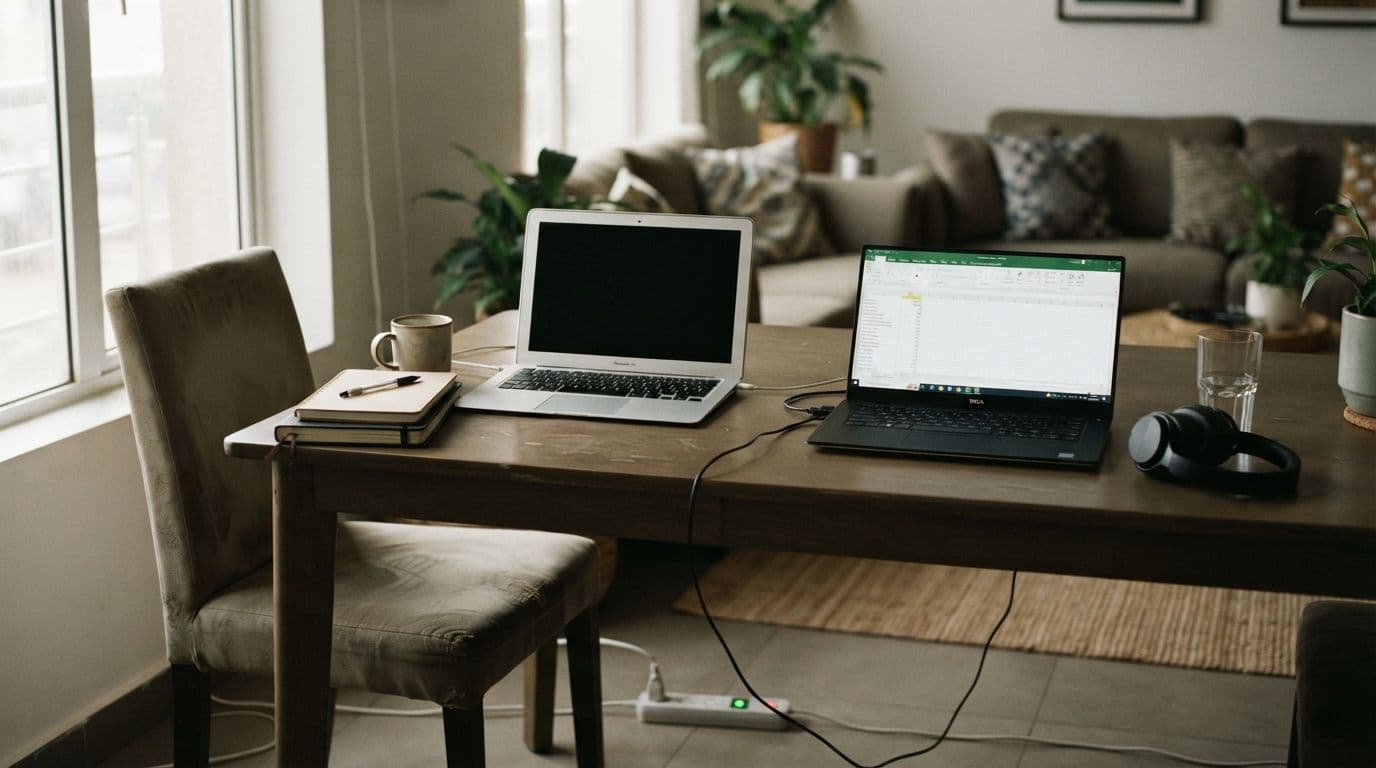
The front door unlocked at quarter past eight on a Tuesday morning with the unbothered familiarity of someone walking into his own corridor.
Tobi dropped his backpack against the mahogany dining chair, uncoiled an orange extension reel, and slotted a second monitor beside the bread basket before taking off his trainers. In the kitchen, Femi had barely poured hot water over his instant coffee.
"The feeder pillar down the street burnt out around midnight," Tobi said, unfastening a lunchbox of boiled plantain. "You have the inverter on today, right? Let me jump on this stand-up call before the bandwidth gets heavy."
Femi leaned against the doorframe in his sleep shorts, staring at the dining table. Three months earlier, Tobi had stopped by twice during torrential June rainstorms when his neighbourhood transformer tripped. Now, October was halfway through, the skies were clear, and Tobi was at the table four days every week.
There was no bad intention behind it. But having a remote-working friend treat your parlour as a satellite office introduces an unexpected strain into everyday adult domesticity, turning a private sanctuary into a high-stakes workstation.
The Shift From Rescue Hospitality to Unpaid Overhead
Sharing amenities during infrastructural shortages is second nature among peers. If one person has a functional borehole or steady battery backup, offering a charge or a quiet corner is an ordinary gesture of neighbourly care. The trouble begins when emergency mutual aid turns into an unacknowledged workplace subsidy.
Running a flat for one quiet resident takes modest power: a laptop charger, an overhead fan, and intermittent Wi-Fi use. Sponsoring two complete remote setups changes the arithmetic entirely. Extra monitors, simultaneous cloud syncing, continuous mobile charging, and repeated kitchen kettle runs drain an inverter bank twice as fast. When the grid drops out, every extra watt shortens the battery life before the evening.
Beyond power, there is the silent cost of provisions and shared logistics. Toilet paper, bottled drinking water, instant coffee, and air conditioning runtime all climb steadily. Because the arrangement starts under the warm banner of friendship, handing your friend a bill for diesel contributions or fiber internet top-ups feels uncomfortable. The resident ends up quietly absorbing commercial overhead inside their own domestic rent.
Much like the domestic exhaustion explored in why that zero-privacy parlour hangout is straining your shared flat, space ceases to be a retreat when private boundaries vanish during working hours.
The Workplace Noise That Erases Domestic Privacy
Noise inside a home is never just a matter of volume; it is about social friction. A television running a documentary in the background does not demand your attention. A friend speaking in a brisk, assertive corporate register two metres from your couch instantly alters the atmosphere.
By eleven in the morning, Femi had relocated to the corner of his bedroom, his laptop propped against a stack of pillows. In the living room, Tobi was conducting an aggressive client review, pacing across the rug with his wireless headset glowing green.
"Let's align on the scope before close of business," Tobi said, his pitch echoing into the hallway.
Femi clicked his bedroom door shut. The issue was not that Tobi was doing bad work; the issue was that Femi had paid rent for a home, not a co-working franchise. Domestic life requires unstructured moments where you can make lunch, listen to an audio message, or walk around in an old t-shirt without feeling like an uninvited extra on an all-hands call.
When basic boundaries around shared space are missing, passive frustration takes over. Long-term studies on companionship emphasize that maintaining stable adult relationships requires deliberate design rather than unspoken expectations, a reality detailed in research on rituals of connection. Without ground rules, the parlour becomes a site of silent conflict.
Why Subtle Dropping of Hints Never Clears the Table
Most hosts try to resolve the intrusion using indirect resistance. They comment pointedly about how hot the inverter batteries are running, sigh while plugging in the router, or announce that they need to leave for an errand in town.
These hints rarely work because the visitor operates from a baseline of absolute comfort. To them, having unrestricted access to your table is proof of an easy, low-maintenance connection. They do not read your quietness as resentment; they read it as the comfortable silence of two people who know each other well.
Compounding the problem is the awkwardness of interrupting someone midway through an eight-hour shift. Once someone has opened four spreadsheets and an active call queue, asking them to pack up feels like sabotage. The resident feels trapped in their own kitchen, reluctant to bring up the friction for fear of looking petty.
This continuous yielding creates the same slow social fatigue documented in why a quiet person should not have to host every time. The pressure builds until it eventually discharges over an unwashed mug or a tangled charging cable.
Moving Collaboration Out of the Domestic Parlour
Preserving a close bond while reclaiming your living room often requires taking work routines out of the house completely. When adult friendships rely entirely on private flats for professional convenience, the resident carries an unfair load.
Sociological findings on community building highlight that adult connections thrive when activities are situated in distinct, shared spaces rather than ambiguous domestic settings, as explored in discussions on how adults embrace play. Shifting work days to commercial desk spaces, neighbourhood cafes, or library hubs redistributes the operational burden.
In an external workspace, both people pay their own day pass, purchase their own drinks, and operate under public workplace etiquette. Neither friend is responsible for cleaning up, maintaining battery levels, or providing uninterrupted quiet.
More importantly, separating work from leisure allows the friendship to return to its original purpose. An evening catch-up over dinner or a casual weekend gathering feels refreshing because it is untainted by the logistical stress of client deadlines, muted microphones, and drained backup power.
The Asymmetry of Remote Schedules and Daily Routines
Friction often escalates not because two friends are occupying the same flat, but because their job requirements move at completely incompatible rhythms. One person may spend their day writing long-form documentation, coding, or handling asynchronous tasks that require deep, continuous blocks of quiet focus. The visiting friend might manage high-touch client accounts, sales demos, or cross-functional team escalations that demand forty-five minutes of rapid speaking every single hour.
When these two cadences clash on the same living room rug, the host is inevitably forced to subordinate their routine to the louder schedule. The quiet worker puts off taking an unscheduled personal call, delays blending soup in the kitchen, and tiptoes around the corridor whenever they spot a glowing green camera light. What begins as an innocent desk share rapidly turns into an involuntary surrender of the flat’s natural pace.
Over time, this asymmetry forces the homeowner into a passive state within their own premises. Rather than feeling grounded in their personal living space, they find themselves working around the deadlines, meetings, and lunch demands of a corporate organisation they do not work for. Negotiating a balance requires recognising that every job carries an environmental footprint, and domestic flats are rarely built to absorb competing professional duties simultaneously.
The Unspoken Friction of Shared House Resources
Beyond noise and desk space, regular uninvited co-working quietly alters the physical maintenance and inventory of a private home. In an ordinary week, an individual resident consumes groceries, bathroom toiletries, and kitchen staples at a steady, predictable rate. When a visiting worker arrives every morning, common supplies deplete at double speed without any natural system to replace them.
Small practical inconveniences accumulate throughout the day. The kitchen counter fills up with double sets of lunch containers, the rubbish bin fills to the brim by early afternoon, and the refrigerator shelves get crowded with leftover takeout boxes and personal drink cartons. The resident often ends up doing extra loads of washing up, cleaning down the dining table before dinner, and emptying communal trash cans simply to restore the home to a baseline of liveable order.
Because these burdens arrive incrementally in tiny increments, they rarely trigger an immediate conversation. Yet the cumulative toll produces steady, low-level resentment. Similar social pressures are examined in the friend who always organises: routine vs obligation, where unmanaged domestic expectations gradually erode good will. When hospitality begins to resemble unpaid facility management, the host inevitably feels taken for granted.
Restoring the Friendship by Protecting the Third Place
When a home is constantly used as an office, the social nature of the relationship itself begins to hollow out. Instead of greeting each other with excitement or catching up on personal lives with genuine presence, the interaction reduces to quick, distracted exchanges between sprint calls, muted microphones, and spreadsheet updates. The flat stops being a place of genuine friendship and turns into a convenient utility stop.
Protecting the bond often means restoring clear boundaries between working hours and recreational time. Friendships flourish when both parties meet with intentional energy, rather than merely drifting into each other's professional stress zones. Agreeing to keep work hours completely separate allows gatherings outside the clock—such as weekend dinners, game nights, or casual neighbourhood strolls—to feel engaging and reciprocal once again.
Taking accountability for one’s domestic privacy does not mean shutting the door on mutual support; it means clarifying the terms under which care is given. Much like the communication patterns explored in stop dragging your exhausted partner to every Lagos hangout, honest boundaries prevent routine exhaustion from masquerading as normal social life. When friends remove workplace logistics from personal living rooms, they protect both the comfort of the home and the durability of the friendship.
Stating the Workday Boundary Without Apology
Clearing the dining table does not require a dramatic showdown. It requires treating personal space with practical directness rather than emotional evasion.
A clear boundary can be delivered simply: explaining that balancing two work routines under one roof makes it difficult to concentrate, and that daytime hours need to remain solo from the coming week. Suggesting specific alternative spots to cowork once a month, or keeping interactions strictly to evenings and weekends, reinforces that the friendship matters even while the open-door desk policy closes.
When Femi returned to the living room that evening, he did not boil water or ask how the sprint call went. He pulled out the chair opposite Tobi, waited for the laptop screen to dim, and stated clearly how the apartment needed to run starting Monday.
Tobi looked surprised for a brief second, took in the room, and nodded. The moment carried a slight sting of awkwardness, but the air in the flat was immediately lighter.
Keep reading
Read next.

Why the Sober Friend Quietly Dreaded Friday Night
When weekend plans cross from the Mainland to Victoria Island, one person stays sober, navigates checkpoints, and pays for the night with silence. The role of the designated driver in Lagos is rarely shared.
Read the story
A Face-Down Phone on Friday Night Explodes Into a Relationship Trial
When one partner craves weekend silence and the other thrives in crowded parlours, an unanswered notification easily turns into an unfair dispute over commitment.
Read the story
Why That Zero-Privacy Parlour Hangout Is Straining Your Shared Flat
In a shared Lagos flat where thin walls kill personal space, a daily parlour hangout quickly became an unwritten law. Here is how flatmates drew the line between routine and obligation.
Read the story