
A Shared Flat Without Privacy Finds Relief in a Lazy Whist Match
When three flatmates in a cramped flat gave up waiting for personal space on a hot Saturday, an improvised card tournament turned cabin fever into genuine ease.
Original fictionBy 18plus Editorial
This story is a work of fiction. Names, characters, and domestic scenarios are products of the author's imagination.
By 2:00 PM on Saturday, the heat inside the three-bedroom flat in Yaba had reached the point where closed bedroom doors were impossible. The generator hummed downstairs, but it was only wired to carry standing fans, not the air conditioners. Keeping a bedroom door shut meant stewing in stagnant air. Opening it meant that every phone call, throat-clearing, and rustling bedsheet spilled directly into the hallway.
For three people sharing 85 square metres with thin drywall, total privacy was a luxury none of them could afford that afternoon.
The Hallway Standoff
Tobi sat at the edge of the dining table with his laptop, trying to review spreadsheets while Tunji paced past him to refill a water mug for the third time in ten minutes. In the armchair opposite the television, Nneka lay with her feet thrown over the armrest, scrolling through videos with one earphone in. Whenever anyone shifted weight, the communal floorboards creaked.
Nobody had done anything wrong, but the close quarters had turned every ordinary movement into a mild irritation. Tobi felt exposed working in the open; Tunji was restless because his room was too hot for a nap; Nneka wanted silence but had nowhere else to sit without sweating.
When co-living forces constant visibility, flatmates often fall into silent, watchful tension. As explored in Tearing Down the Invisible Scorecard in a Tight Shared Flat, small domestic frictions multiply when people treat shared spaces like contested territory instead of shared shelter.
"Tunji, if you open that fridge one more time, the ice water will turn to bath water," Nneka muttered, not looking up from her screen.
"The parlour is hot, Nneka," Tunji replied, leaning against the counter. "Unless you want to sponsor fuel for the big gen, we are all suffering together."
Dropping the Performance
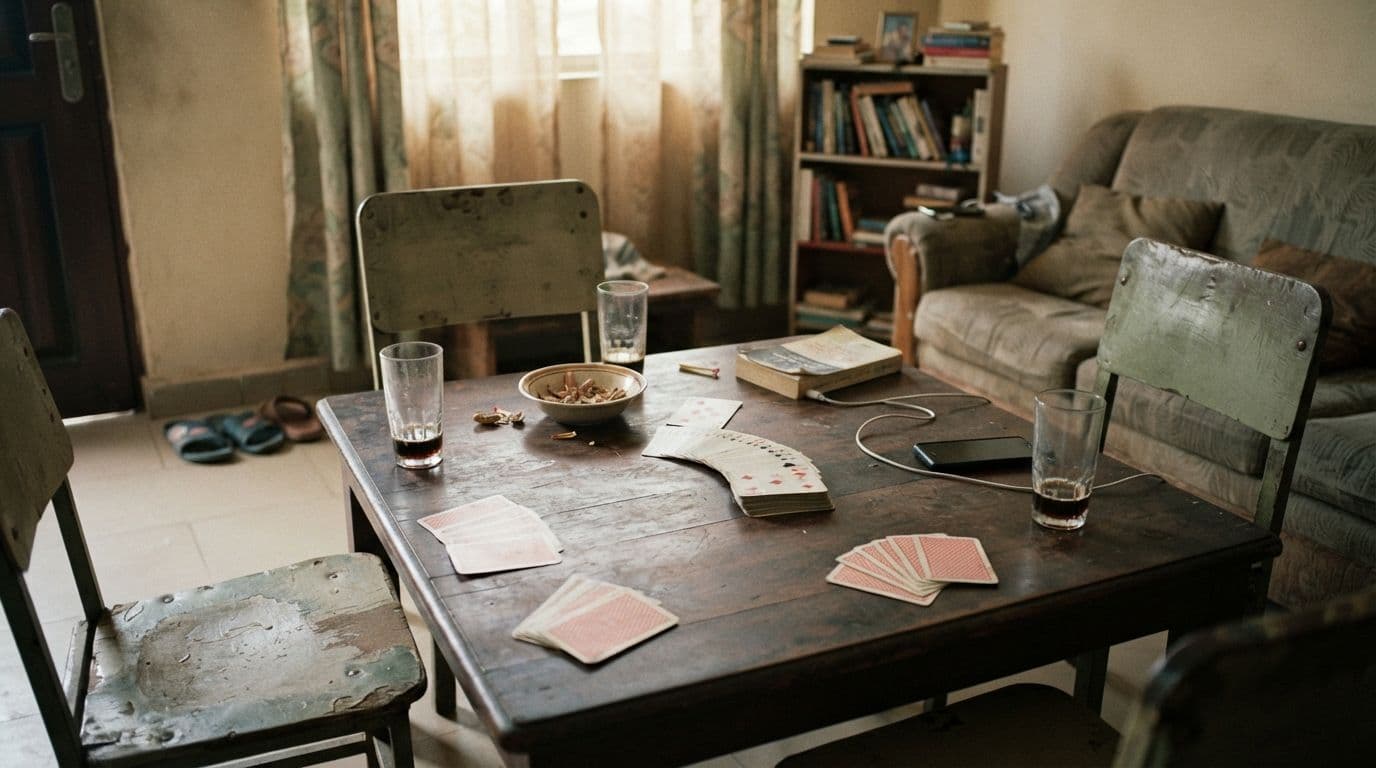
Tobi closed his laptop with an audible snap. He could have retreated to his sweltering room to nurse his annoyance, but that would only prolong the discomfort. Instead, he reached into the drawer beneath the router and pulled out a faded deck of playing cards with rounded, frayed corners.
"Whist," Tobi said, dropping the deck onto the glass table. "Loser buys two bags of pure water from the junction when the sun goes down."
Tunji paused, looking at the cards and then at his empty water mug. Nneka pulled out her remaining earphone and sat up.
"Standard rules?" Nneka asked, sliding off the armchair onto the linoleum rug. "No renegotiating tricks halfway through."
"Standard rules," Tobi said.
In that moment, the posture in the room shifted. Rather than guarding their private bubbles in a space too small to sustain them, they leaned directly into the common area. Rather than turning the shared area into an awkward waiting room—a pattern detailed in Your Shared Parlour Is Not an After-Hours Reception Lounge—they created an intentional, low-stakes reason to occupy it together.
The Function of Unplanned Play
They played five rounds on the bare rug, using a stray receipt and a blunt pencil to keep score. The game required just enough attention to stop everyone from brooding over the humidity, but not enough focus to create real competition. Tunji accused Tobi of hiding trumps; Nneka deliberately threw a hand to force Tunji into a loss; Tobi laughed so loudly at a misplay that the tension from his abandoned spreadsheets evaporated completely.
When flatmates cannot buy physical distance, shared play acts as a social release valve. Research on adult connection shows that participating in simple, low-barrier activities creates trust and emotional synchrony without requiring intense, vulnerable conversations (When adults embrace play, they create community). By focusing on an arbitrary game, they stopped monitoring each other's moods and simply shared an afternoon.
This kind of low-pressure gathering mirrors the advice in Ditching the Weekend Reservation: How Low-Stakes Asks Build Honest Community. Connection does not require an expensive outing or an official occasion; it often happens on a living room rug with whatever items are within reach.
Practical Choices for High-Density Living
By 5:30 PM, the direct afternoon sun had slipped behind the opposite compound wall, and a cooler breeze moved through the balcony louvres. The game ended with Tunji down by forty points. He stood up, stretched, took the plastic tote bag from the kitchen door, and walked downstairs to buy the water without a complaint.
Living in close quarters without personal privacy requires practical adjustments:
- Acknowledge the physical limits: Pretending a tight parlour is a private study will only breed resentment. When the climate or layout forces everyone into the centre, adjust expectations about silence. - Use low-stakes activities to break cabin fever: A deck of cards, peeling groundnuts together, or sharing a quick meal reduces the pressure of enforced proximity. - Let go of the defensive posture: When personal space is temporarily unavailable, leaning into ordinary companionship is far less draining than guarding an imaginary boundary.
Tobi reopened his laptop after Tunji left, but the heavy silence from earlier was gone. The flat was still small, the drywall was still thin, and their schedules were still hectic. But for three hours on a hot Saturday, they had traded claustrophobia for ease.
Keep reading
Read next.

Making Quality Time Work on an Exhausting Nigerian Workweek
Quality time does not require a four-hour dinner or a silent weekend getaway. Here is how to build practical connection into ordinary, busy workweeks.
Read the story
Five Screen-Free Games for Couples at Home That Need No Boxed Sets
Turn off the TV and skip commercial prompt decks. Here are five low-stakes games two adults can play on a rug using standard cards, pens, scrap paper, or a shared playlist.
Read the story
Three Questions to Ask Your Boyfriend Before Planning the Next Quarter
Ditch the endless relationship quizzes. Three concrete questions about routines, outside friendships, and money expectations can reset your shared rhythm without turning into an interrogation.
Read the story