
Four Chairs at Mende: Surviving the Awkward First Compromise of Unequal Social Capacities
When one partner needs buzzing rooms and the other runs out of steam by 9 PM, the first step towards a sustainable weekend isn't perfection—it is surviving a stiff, low-stakes experiment.
An 18plus originalBy 18plus Editorial
The bolt on the front door had already slid shut, but Tobe stayed standing by the shoe rack in the Mende flat, car keys dangling from his index finger. It was twenty minutes past eight on a Saturday evening. On Victoria Island, the rooftop table Ifeoma had reserved with four of her agency colleagues was filling up. Tobe had calculated the journey: forty minutes across the Third Mainland Bridge, twenty minutes finding parking near Ahmadu Bello Way, and then three solid hours of shouting across deep-bass speakers about quarterly brand campaigns he had nothing to do with.
Ifeoma caught him staring at the hall mirror. She had spent the last hour pressing her linen shirt and touching up her eyeliner, visibly energized by the prospect of a late night outside their four walls. Her work in client relations ran on endless polite crisis management, leaving her Saturdays as the only stretch where she could speak freely without drafting an email in her head. To her, staying home felt like an extension of the working week; to him, stepping into a noisy lounge was taking on an unpaid shift.
"You're already doing the face," she said, leaning against the doorframe with her bag over her shoulder. "The car hasn't even arrived and you've already checked out."
"I'm not doing any face," Tobe answered quietly. "I'm just tired. If we go, I will be useless by ten o'clock, and then you will spend the entire night asking me why I'm sitting like a bodyguard."
Having very different social batteries creates this exact stalemate in long-term relationships. The outgoing partner feels socially restrained by a quiet spouse, while the lower-capacity partner feels dragged into sensory overstimulation purely to prove their loyalty. The real problem rarely lies in a lack of mutual care; it stems from the false belief that shared leisure must always be an all-or-nothing affair.
The High Cost of the Forced Public Appearance
For months, their routine had swung between two equally frustrating extremes. Either Tobe gave in and followed Ifeoma to crowded island bars—numbing out on his phone after forty minutes while she apologized to friends for his silence—or Ifeoma stayed on the sofa in Mende out of guilt, watching him read in total silence while her own evening evaporated.
When one partner repeatedly acts as an unenthusiastic tag-along, both people lose dignity. The quieter person feels like an accessory whose only duty is physical attendance, while the more social partner ends up monitoring their spouse's body language instead of enjoying their friends. As explored in Stop Dragging Your Exhausted Partner to Every Lagos Hangout, forcing a partner into spaces that drain them invariably poisons the atmosphere for everyone at the table.
Tobe’s resistance wasn't disdain for her circle. "It's the performance," he told her, sitting down on the shoe bench. "I don't have the bandwidth to shout over amapiano tracks and explain fintech infrastructure to three people I just met. By the second hour, my head is pounding."
"And my issue isn't that you have to become an entertainer," Ifeoma countered. "It’s that when we only stay indoors, our entire life feels like waiting for Monday morning. I want people around us sometimes without it feeling like an interrogation."
The Awkward Intermediate Step
Instead of ordering the ride to Victoria Island or retreating into defensive sulking on opposite ends of the couch, they chose a middle path they had avoided for months: inviting one couple from down the street over for two hours, centered on a specific card game, with a fixed closing time.
It was not a smooth transition. When their neighbors, Emeka and Boma, knocked at quarter to nine, the Mende parlour felt instantly stiff. Without the sensory shield of a loud restaurant, every pause in conversation sounded magnified. Tobe fumbled with the glasses in the small kitchen, while Ifeoma fought the urge to put on a loud music playlist just to fill the quiet.
Yet, that very awkwardness was necessary. Most couples abandon compromise because they expect the first attempt to feel instantly magical. When it feels slightly clumsy instead, they retreat to their old corners. But replacing high-friction outings with structured domestic time creates an easier container for connection. In a study on community interactions, the Greater Good Science Center on how play builds community points out that shared activities lower the stakes of social entry because people can focus on the mechanics of a game or task rather than having to generate continuous sparkling banter.
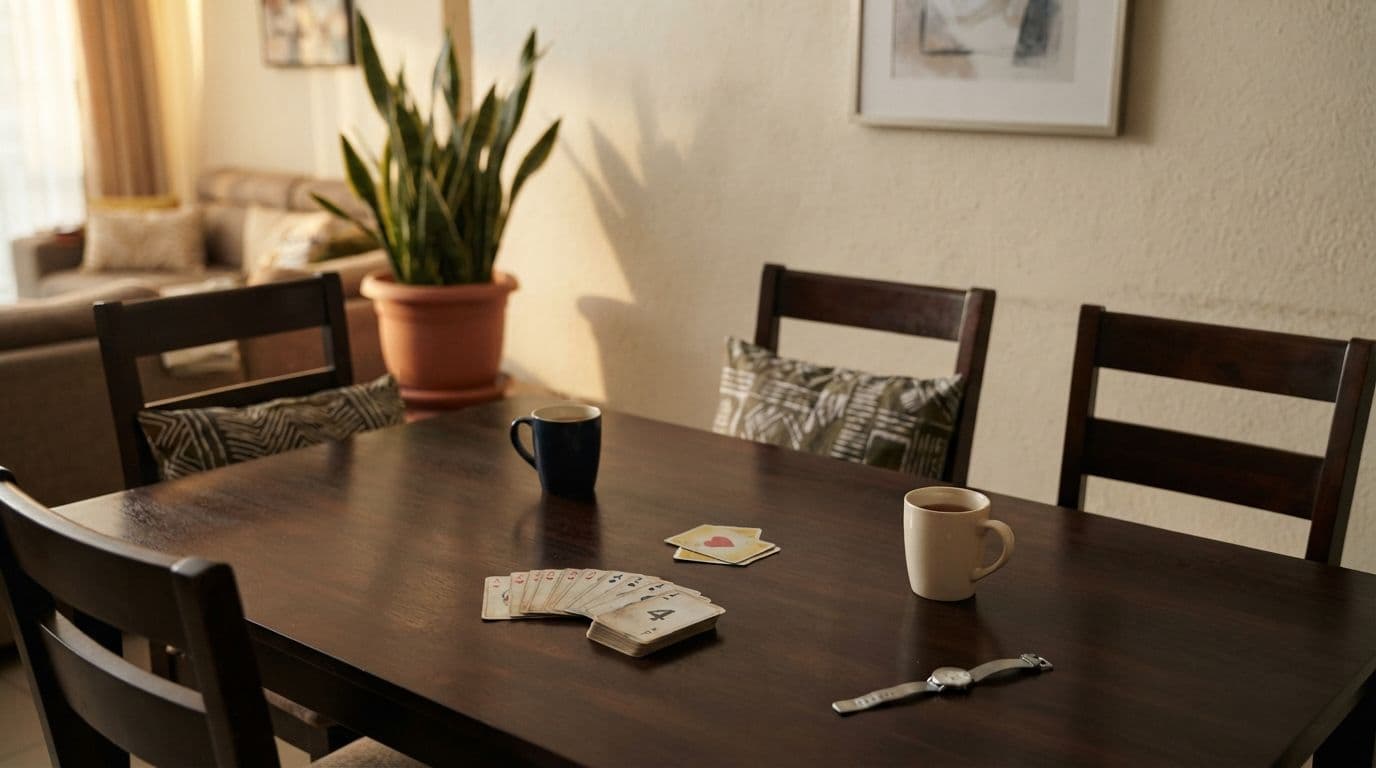
Once the card deck was dealt onto the dining table, the demand for small talk vanished. Tobe did not need to pitch his personality to strangers; he only had to play his hand and track the discards. Ifeoma did not have to carry the whole room's energy; the competition generated its own momentum. Within thirty minutes, the early stiffness gave way to animated arguments over house rules and disputed points.
Reclaiming Household Space Without Host Burnout
One reason lower-energy partners dread home gatherings is the invisible labor attached to them. To Tobe, having people over had always sounded like hours of pre-cleaning, serving drinks, and wondering when guests would finally leave. Hosting can easily turn into an endurance test if there are no guardrails.
To prevent the flat from feeling like a public venue, they set basic operational rules before anyone arrived:
- A Clear Finish Line: They agreed beforehand that the evening would wrap up after three rounds of the card game, roughly around eleven o'clock, giving Tobe a clear end in sight. * Zero Kitchen Slavery: Instead of cooking a multi-course dinner that kept one person anchored to the stove, they ordered suya and plantain chips from a nearby junction spot, served straight from the brown paper. * Defending Private Space: The bedroom door stayed firmly closed. The parlour was shared territory for two hours, but the rest of the flat remained private.
As discussed in Your Shared Parlour Is Not an After-Hours Reception Lounge, domestic hospitality works only when boundaries protect the home from becoming an exhausting second workplace. When the quiet partner knows the gathering will not spill into an unmanageable midnight marathon, their willingness to participate rises dramatically.
The Trap of Silent Monitoring
Before they started testing small domestic evenings, the biggest drain on their relationship was not the venues themselves, but the anxious surveillance that happened inside them. Whenever Ifeoma convinced Tobe to attend an after-work mixer or a friend’s birthday lounge in Lekki, she spent half her night scanning his posture across the table. A tight jaw, a glance at his wristwatch, or ten quiet minutes spent nursing a single bottle of soda signaled impending collapse. Instead of enjoying her conversation, she found herself constantly calibrating his comfort, feeling responsible for his boredom while growing secretly resentful that he could not simply blend in.
From Tobe’s seat, that constant oversight felt suffocating. He knew that any pause in his participation would be read as a silent protest. "When you keep asking me if I’m okay every fifteen minutes, it makes me feel like a problem you have to manage," he confessed during one drive home along the expressway. "I am just sitting there quietly, but to you, it looks like an emergency." That dynamic turned every outing into an emotional calculation, where one person performed forced cheerfulness while the other carried the exhausting job of crowd control.
Learning to dismantle this habit meant separating personal enjoyment from partner surveillance. When they shifted to smaller, structured gatherings at home, they agreed to stop managing each other's reactions in real time. If Tobe chose to step onto the balcony to answer a call or quietly wash a glass in the kitchen during a game pause, Ifeoma refrained from checking in or smoothing things over. Releasing each other from constant emotional monitoring, as touched upon in A Face-Down Phone on Friday Night Explodes Into a Relationship Trial, gave both of them permission to exist at their natural pace without turning an ordinary lull into a crisis.
Normalising the Asymmetrical Weekend
Accepting different social limits also meant uncoupling their weekend calendars so that companionship did not require constant physical proximity. For years, they had operated under an unwritten rule that being a committed couple meant arriving together and leaving together at every social function. If an invitation came from an old university friend or an office peer, it was automatically treated as a dual booking. That assumption forced unnecessary friction into every Friday planning conversation, turning a routine weekend into a zero-sum negotiation over whose preference would prevail.
The real breakthrough came when they treated solo attendance not as a relationship failure, but as a healthy division of social labor. Ifeoma began attending high-energy bridal showers and crowded industry dinners on Victoria Island by herself, taking a dedicated ride home without rushing her evening. Tobe stayed in Mende, enjoying four uninterrupted hours of reading, football highlights, or meal prep. Because neither person had compromised under pressure, they returned to each other without the subtle bitterness that comes from forced compliance.
Setting up these separate tracks required unlearning the worry about external appearances. In social circles where showing up without a partner often sparks intrusive questions, they had to become comfortable offering simple, neutral explanations. "Tobe sends his regards; he’s resting this evening" replaced elaborate excuses or defensive over-explaining. Normalising the solo exit or the split schedule, similar to the practical boundaries highlighted in Stop Waiting for a Milestone to Gather Your Friends, ensured that leisure remained restorative rather than an obligation performed for the sake of other people's expectations.
Designing the "Low-Capacity" Evening
To make their shared social life sustainable beyond the occasional card game, Tobe and Ifeoma developed a rotating menu of low-friction formats that did not demand extensive emotional energy. Rather than defaulting to open-ended dinners that could drag into late hours, they focused on brief, purpose-driven meetups built around a single activity. A ninety-minute visit to an art exhibition in Onikan on a Sunday afternoon, followed by a quick plate of pepper soup near the car park, provided enough shared stimulation for Ifeoma while giving Tobe a predictable timetable with minimal required chatter.
Another staple became the neighborhood errand run turned casual meetup. Instead of sitting through a formal sit-down meal, they occasionally invited a friend to join them for a late-afternoon walk to a nearby supermarket or a bakery run in Maryland. The moving setting and ambient street noise removed the pressure of direct, sustained eye contact, making conversation feel light and unforced. When the shopping bags were packed into the boot, the gathering naturally reached its conclusion without any awkward lingering or debated goodbyes.
These low-capacity formats proved that social connection does not have to be expensive, loud, or all-consuming to be meaningful. By swapping marathon nights out for contained, predictable interactions, they protected Tobe’s need for quiet downtime while feeding Ifeoma’s appetite for community. When couples stop measuring the quality of their social life by the volume of the room, they can build shared routines that honor both temperaments without draining either person’s reserves.
Practicing Connection Over Performance
A durable partnership does not require identical temperaments; it requires predictable rituals that both people can trust. In their research on marital stability, the Gottman Institute's insights on relationship rituals emphasize that deliberate, repeatable habits of connection provide emotional stability even when daily life is demanding.
For Tobe and Ifeoma, learning to live with their differing capacities meant abandoning the fantasy that every weekend had to be a cinematic celebration. By eleven-fifteen, the cards were boxed, the plastic cups were tossed into the bin, and Emeka and Boma were walking back to their own block.
Tobe stood by the dining table, wiping down the wood with a damp cloth, looking calm rather than depleted. Ifeoma turned off the overhead light, leaving just the warm floor lamp on.
"It wasn't a rooftop party," she said, leaning over the back of the dining chair.
"No," Tobe said, looking up with a half-smile. "It wasn't. But I actually enjoyed myself, and I don't feel like I need three days in a dark room to recover."
Making room for an awkward first trial does not solve every social disagreement. There will still be weekends when Ifeoma goes out with her colleagues alone, and evenings when Tobe stays behind without feeling guilty. But having a low-pressure middle ground means that compromise no longer feels like a penalty. When couples give themselves permission to start small, stumble through the initial stiffness, and prioritize ease over spectacle, they build a shared life that neither partner has to escape from.
Keep reading
Read next.

A Standby Spot at Maryland Replaces the Weekly Chore of Social Planning
When one friend carries the mental load of every weekend plan, quiet resentment grows. A low-friction hangout ritual replaces the exhaustion of endless coordination.
Read the story
A Missed Voice Note After Relocation Turned Our Quiet Gap Into an Open Trial
When Folarin relocated to Abuja, an unlistened voice note turned an ordinary delay into a bitter argument about social rank, busy lives, and the fragility of distance.
Read the story
The 8 PM Guest Who Refuses to Leave Your Parlour
A casual evening visit shouldn't hijack your weekend. When a close friend turns every drop-in into an uninvited sleepover, quiet hosts must learn to close the door.
Read the story